Dysphagia typically
presents as a common symptom of head and neck cancer or sequelae of its management
(Gaziano, 2002). Scaring, from surgical
dissections in the cervical, upper extremity, and head/neck area, appears to be
a universal condition affecting swallowing function. Scaring contributes to
adhesions that limit interstitial fluid flow and muscle/tissue pliability. Also,
“tissue changes” from treatment methods that address cancer management, affect skin
integrity and decrease patient tolerance of stimulation for uses of modalities
in these areas.

Image obtained from https://i.pinimg.com/236x/68/49/78/684978bd0da7a77bf479bf55a931f43e.jpg
Heather Lazarides, certified in the Kinesio Taping® Method, and SLP specialist in swallowing disorders associated with H&N cancer, recommends the following information to consider when using Kinesio Tape®:
1. There is
no “magic placement” (when using Kinesio Tape®) to improve swallowing.
a. First,
provide a global assessment to identify what is causing the dysphagia.
b. Next, identify how Kinesio
Tape® can help treat for the relevant co-morbidities, additional
pathologies, and secondary impairments associated with the etiology.
2. Physical symptoms to
pay attention to:
a. Scars: Scaring from a lateral neck dissection can restrict laryngeal
elevation.
b. Lymphedema:
Assess to see if s/s of swelling on the patient’s suprahyoids is contributing
to a decrease in hyoid excursion and epiglottic retroflexion.
c. Shoulder
dysfunction: This can be a secondary impairment from a radial neck dissection
and removal of CN XI.
3. I
do feel that Kinesio Tape® is a valuable tool for SLPs to use, specifically
those who specialize in H&N cancer. Taking the standardized Day 1-Day 3
curriculum can help to learn how to assess and problem solve how to apply
Kinesio Tape® more exclusively in
this area.

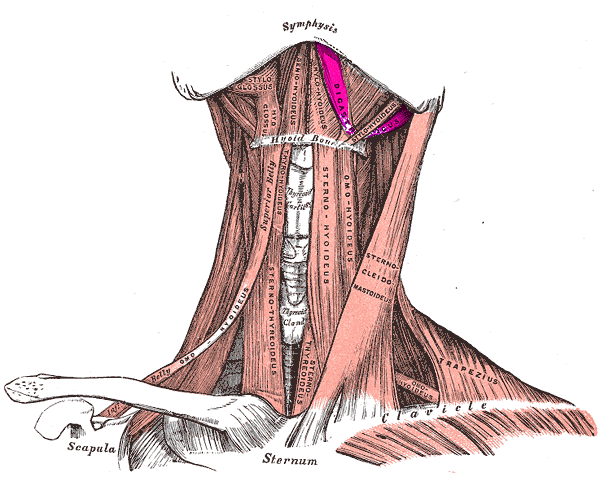
Image obtained from http://www.wikidoc.org/images/c/ca/Digastric_muscle.PNG
Speech Language Pathologists are an up and coming Kinesio Taping® discipline. It is always so good to hear from a fellow SLP interested in learning more about how to use Kinesio® Tape!!
Click here to see upcoming Kinesio Seminars
References:
• De Ru, E. (2017). Clinical Notes: Elastic
therapeutic taping in Paediatrics: Best Practice. Is applying Elastic
Therapeutic Tape on the skin of pre-term infants (NICU) and new-borns safe?
Retrieved from https://www.academia.edu/31331942/Clinical_Notes_2_ETT.
• Gaziano, J.E. (2002). Evaluation and
management of oropharyngeal dysphagia in head and neck cancer. Cancer Control, 9(5), 400-409.
• Goodridge, S., (2012). Kinesio Tape
application on hypertrophic scar formation. Retrieved from: http://www.aevnm.com/docs/socios/Articulos/Aut-Goodridge%20S.pdf, on 3/28/18.
• Harvey, E.G.,
Macias-Harris, J., Brown, K.M. (2017). A Prospective Study of the Posture and Sensory Stimulation Method Using
a Touch, Treat, Tape Approach (PaSS Method®) to Affect Functional Outcomes in
Children with Dysphagia. NDTA Network, May-June 2017, Emotion and Regulation, 24/3,
Special Research Report, 1-15.
Information presented in this blog is designed to promote ideas and stimulate discussion. The goal of this blog is to provide a safe and friendly place to share stories or experiences, build an understanding of various teaching and treatment styles, and to network with each other.
The author(s) of this blog do not dispense
medical advice nor prescribe the use of information as a form of treatment for
medical problems with or without the advice of a physician. The intent of the
author(s) is only to offer information of a general nature to help you
cooperate with your doctor and clinical members in your mutual quest for good
health. In the event you use any of the information in this blog for yourself,
you are prescribing for yourself. The author(s) assume no responsibility for
your actions, assessment, nor interpretations. No one associated with this blog
will have liability for loss, damage, or injury, resulting from the use of any
information found on this or any other page at this site.


No comments:
Post a Comment